Museum of Australian Democracy at Old Parliament House
Cart Icon Shop Support Icon Support Search Icon Search

MoAD and the Courtyard Cafe are open. Some exhibitions and rooms will be closed from September 2025 for essential building works. Learn more

Main navigation

Visit

What's on Getting here and parking Access Plan a school visit Group tours Food and dining Shop Map

Learn

School visits Digital excursions and events Professional development Activities and resources

Play

Play at home Play at the museum

Explore

Democracy Collection Stories Political cartoons

Support

Donate Partnerships Volunteer Donate to collection

About

Old Parliament House Board of Old Parliament House Reports, policies and plans Access to information Media Careers Venue hire Contact
Main mobile navigation

Visit

What's on Getting here and parking Access Plan a school visit Group tours Food and dining Shop Map

Explore

Democracy Collection Stories Political cartoons

Learn

School visits Digital excursions and events Professional development Activities and resources

Play

Play at home Play at the museum

Support

Donate Partnerships Volunteer Donate to collection

About

Old Parliament House Board of Old Parliament House Reports, policies and plans Access to information Media Careers Venue hire Contact
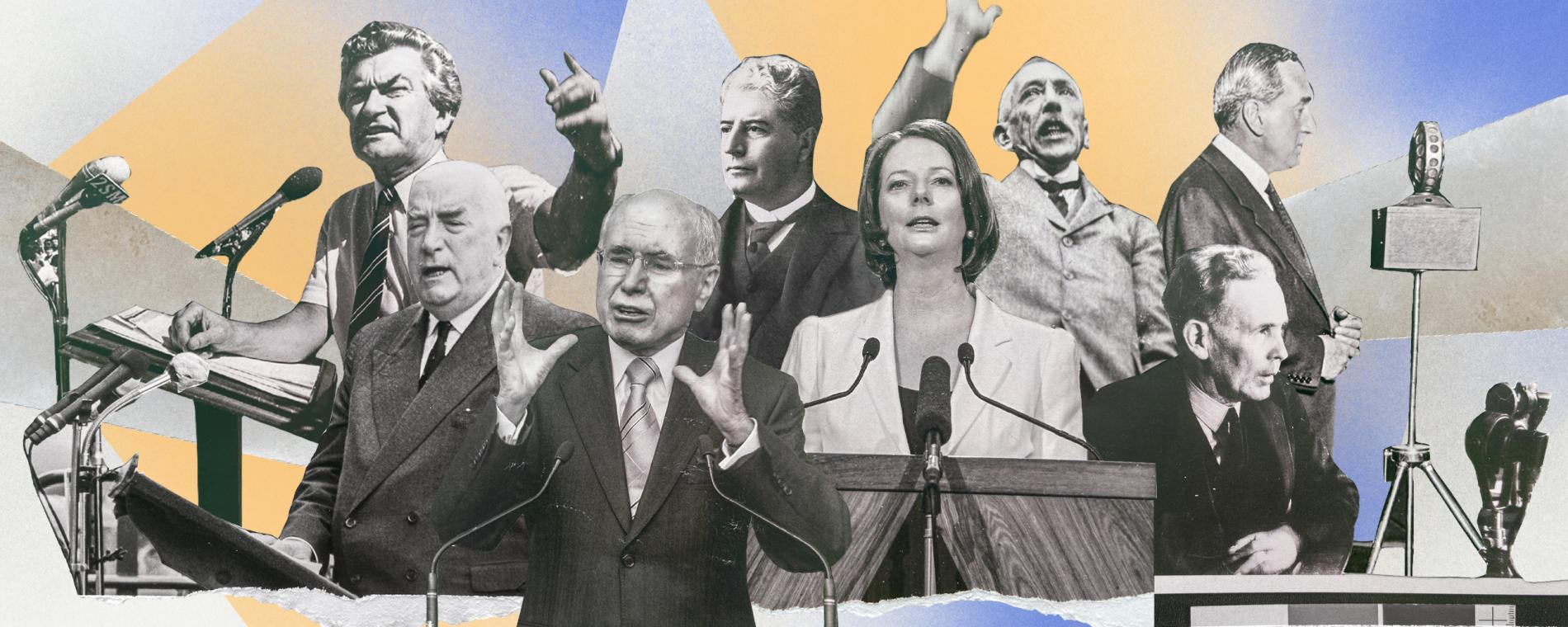
A collage graphic of prominent Australian politicians making speeches.
  • Home
  • Explore
  • Democracy
  • Election speeches
  • Search

Search results

Showing 12 results of 96

Billy Hughes – 1917
The Prime Minister (Mr. Hughes) had a rousing reception when he opened the Win the War campaign at Bendigo on Tuesday, March 27. Long before the time for beginning the meeting the building was crowded in every part, and a large number of people failed to gain admittance. It is estimated that there were over 3,000 people present. When Mr. Hughes appeared on the platform he was enthusiastically cheered. The mayor of the city (Councillor Beebe) occupied the chair. Besides Mr. Hughes, there were on...
  • defence
  • economy
  • immigration
  • trade
Billy Hughes – 1919
Before setting out the present circumstances of the Commonwealth and the policy of the Government in regard to them, it is proper that I should give an account of our stewardship, in order that the electors may judge from that which we have done who is best fitted to lead this country during the period of reconstruction which now confronts us. The National Party - what it is Let me remind you of the circumstances in which the National Party came into existence, so that you may see what manner of...
  • defence
  • economy
  • government administration
  • health
  • immigration
  • industrial relations
  • social security
  • trade
Billy Hughes – 1922
The Parliament elected by the people in 1919 has run its course; a new one has to be chosen; the Government to whom you then entrusted the reins of power again appeals to you for a renewal of your confidence. We have held office for nearly six years. As we have borne the heat and burden of the day during the most trying period in the history of the Commonwealth, it is only proper I should review our record, remind you of the principles for which we stand, and declare the polity upon which we...
  • agriculture
  • communications and technology
  • defence
  • federal capital
  • foreign affairs
  • health
  • immigration
  • industrial relations
  • water
  • White Australia policy
Frank Tudor – 1917
Sixteen years ago today, the first Federal elections were held. Since then, I have always topped the poll. If they do me the honour of opposing me on this occasion – and they say they will – [An interjector: ‘Let them all come!’ followed by cheers] Candidly, I do not mind a fight; it will not be upon my shoulders, but upon yours. [Hear, hear] After two or three meetings I shall be more in the other States than in Victoria, until the last week. The strength of the Labor movement has been...
  • agriculture
  • defence
  • federal-state relations
  • trade
Frank Tudor – 1919
The Government could, under the war legislation, have dealt effectively with the profiteering evil - that it had indeed promised to do so - but it could not be moved into action, how could this be wondered at when one realised that the representatives of the capitalists, the profiteers, and the exploiters, ere on the side of the so-called Nationalist party. The recommendations of the Interstate Commission, obtained at a cost of thousands of pounds as a result of inquiries into the cost of...
  • economy
  • government administration
  • industrial relations
  • social security
Matthew Charlton – 1922
Source: The Register (Adelaide), Wednesday 25 October 1922, page 10 Report of ALP Opposition Leader, Matthew Charlton’s speech to launch the party’s 1922 election campaign. Sydney, 24 October 24, 1922 Labour’s policy 'Unlimited Legislative Powers.' 'Do Away With Costly Governors.' The Leader of the Federal Opposition (Mr. M. Charlton), in delivering his policy speech at West Maitland this evening, before an attendance of about 300, complained of Mr. Hughes’s trick of changing the date of his...
  • defence
  • industrial relations
  • social security
Matthew Charlton – 1925
At the last elections Mr. Hughes was Prime Minister, Mr. Bruce was Treasurer, Mr. Page was leader of the Country Party. Mr. Bruce denounced Mr. Page as the leader of a gang of mental paralytics, whose policy would ruin the country, and Mr. Page retorted by describing Mr. Bruce as a balance sheet maker, a man who manipulated loans and revenue accounts in order to make the budget look as favourable as possible. Mr. Bruce informed the public that Mr. Hughes was the only man qualified to lead the...
  • economy
  • employment
  • health
  • industrial relations
  • trade
Stanley Bruce – 1925
In the past, it has been the practice for the Prime Minister in announcing the policy of his party to recite in the greatest detail the record of the Government, to set out a defence of all its actions, and to make elaborate promises which are designed to attract different sections of the electors to support the Government. This practice has led to elections becoming contests in which parties endeavour to outbid each other for the people’s favour, and in which an appeal is made to the cupidity...
  • defence
  • economy
  • federal capital
  • federal-state relations
  • immigration
  • industrial relations
  • social security
  • trade
  • White Australia policy
Stanley Bruce – 1928
Tonight, it is again my duty to announce to the country on behalf of the Government the policy which we propose to carry out should the people continue their confidence in us, by again returning us to power. Nearly six years ago the Government came into office as a result of a working arrangement between the Nationalist and Country Parties. This arrangement has continued ever since and as a result of the co-operation and loyal support accorded to the Government by the members of both parties it...
  • economy
  • employment
  • family
  • federal-state relations
  • immigration
  • industrial relations
  • infrastructure
  • trade
  • White Australia policy
Stanley Bruce – 1929
Tonight, it is again my duty to announce to the country on behalf of the Government the policy which we propose to carry out should the people continue their confidence in us, by again returning us to power. There is one issue and one only involved in this election. That issue has been defined in Parliament, both by the Government and the Opposition. This election is accordingly unique. On every other occasion there have been many questions of policy upon which the judgment of the electorate has...
  • economy
  • industrial relations
James Scullin – 1928
Bearing tonight for the first time the responsibility of delivering the policy of Labor as its Leader, I desire to place on record our high appreciation of Mr. Charlton, my predecessor, for his long and invaluable service to the Labor Movement, and to Australia, as well as of the sincerity and honesty which he always manifested in that service. A General Election gives to the people the right once every three years to pronounce judgment upon their representatives, and to determine at the ballot...
  • defence
  • federal-state relations
  • immigration
  • Indigenous affairs
  • industrial relations
  • infrastructure
James Scullin – 1929
No full transcript of this speech has yet been located. The following is a press report of Scullin’s speech. Labor Leader Scullin opens up campaign The Richmond Town Hall was crowded to the doors on Thursday night last, and an overflow meeting had to be held outside in the rain, when the Leader of the Federal Parliamentary Labor Party (Mr. Scullin) delivered his policy speech. Mr. Scullin was given an enthusiastic hearing. Many of the points he made were cheered. Cr. H. M. Cremean, ex-Mayor of...
  • economy
  • federation
  • industrial relations

Pagination

  • First page « First
  • Previous page ‹ Previous
  • Page 1
  • Current page 2
  • Page 3
  • Page 4
  • Page 5
  • Page 6
  • Page 7
  • Page 8
  • Next page Next ›
  • Last page Last »

Discover patterns in political speech

Explore how language in Australian election speeches has evolved – from the rise of terms like internet and terrorism, to shifts in readability and speech length over time.

Footer

Stories, ideas and news in your inbox

02 6270 8222 info@moadoph.gov.au
  • Facebook
  • Instagram
  • Twitter
  • Youtube

Visit

  • What's on
  • Getting here and parking
  • Access
  • Food and dining
  • Plan a school visit
  • Group tours
  • Shop
  • Map

About

  • Old Parliament House
  • Board of Old Parliament House
  • Reports, policies and plans
  • Access to information
  • Media
  • Careers
  • Venue hire
  • Contact

Learn

  • School visits
  • Digital excursions and events
  • Professional development
  • Activities and resources

Support

  • Donate
  • Partnerships
  • Volunteer
  • Donate to collection

Play

  • At the museum
  • At home

Explore

  • Democracy
  • Collection
  • Stories
  • Political cartoons

The Museum of Australian Democracy acknowledges Australia's First Nations peoples as the Traditional Custodians of Country throughout Australia. We recognise their continuing connection to land, waters and community. We respectfully acknowledge the role that First Nations people continue to play in shaping Australia's democracy. We also acknowledge the Ngunnawal, Ngunawal and Ngambri peoples as the Traditional Custodians of the region in which MoAD is located. Aboriginal and Torres Strait Islander people should be aware that this website may contain images, voices and names of deceased people.

© Copyright 2026 Museum of Australian Democracy at Old Parliament House Privacy Statement

MOAD house logo